An angel investor is a private individual who backs early-stage startups with their own capital, usually in exchange for equity. Becoming one in Europe takes four things: capital you can afford to lose, a basic grasp of how startup deals work, access to quality deal flow, and the discipline to build a portfolio rather than make a single bet. You can start from roughly €5,000–10,000 per deal through a syndicate or SPV — you do not need a fund.
That is the short answer. The rest of this guide is the version you actually need before writing your first cheque — the market, the money, the mechanics, and the mistakes that quietly end most angel careers before they begin.
Is angel investing in Europe actually worth it?
Let’s be honest up front, because the people who skip this part are the ones who get hurt.
European angel investing has grown from a handful of networks in the late 1990s into a genuine asset class. EBAN estimates the total European angel market at roughly €7.5 billion a year, with tens of thousands of startups receiving pre-seed, seed and Series A funding from angels annually. There are now more than 450 active angel communities across the continent, up from roughly 50 networks in the late 1990s.
So the opportunity is real and expanding. But the return profile is unforgiving, and you need to internalise it before you fall in love with your first founder.
Angel investing obeys the power law. A tiny number of investments generate almost all the returns; most return little or nothing. The distribution looks roughly like this across the industry:
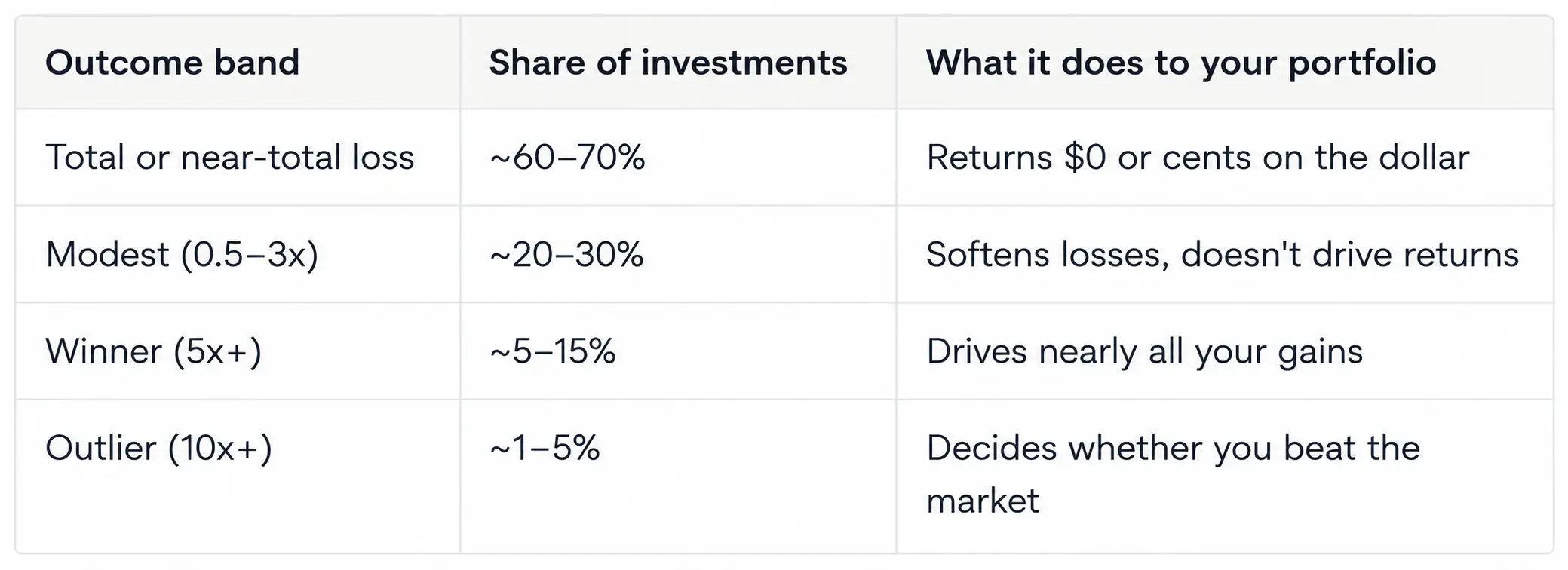
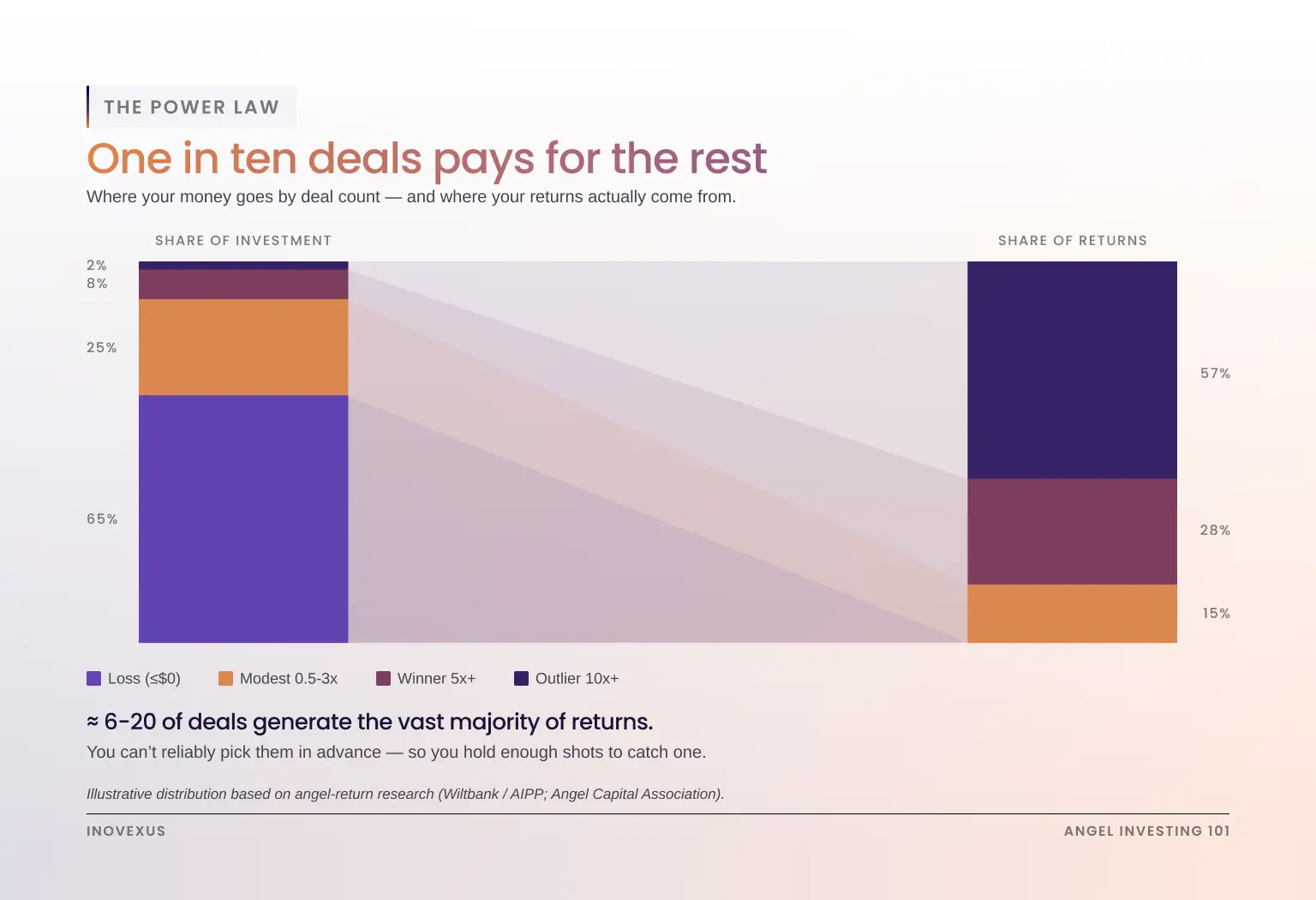
A 60–70% failure rate is baseline reality across all angel portfolios regardless of investor skill — in the most-cited dataset, 52% of exits returned less than the capital invested and only 7% returned more than 10x. The winners are supposed to pay for the losers. This is why the single most important number in this entire guide is portfolio size, not deal selection.
Here’s the uncomfortable comparison every honest guide should show you: $20,000 in an S&P 500 index fund for eight years at historical ~10% annual returns compounds to roughly $43,000 — and it stays liquid, while angel investments are locked up for seven to ten years. If you can’t beat that after illiquidity and losses, you’re paying for entertainment, not building a portfolio.
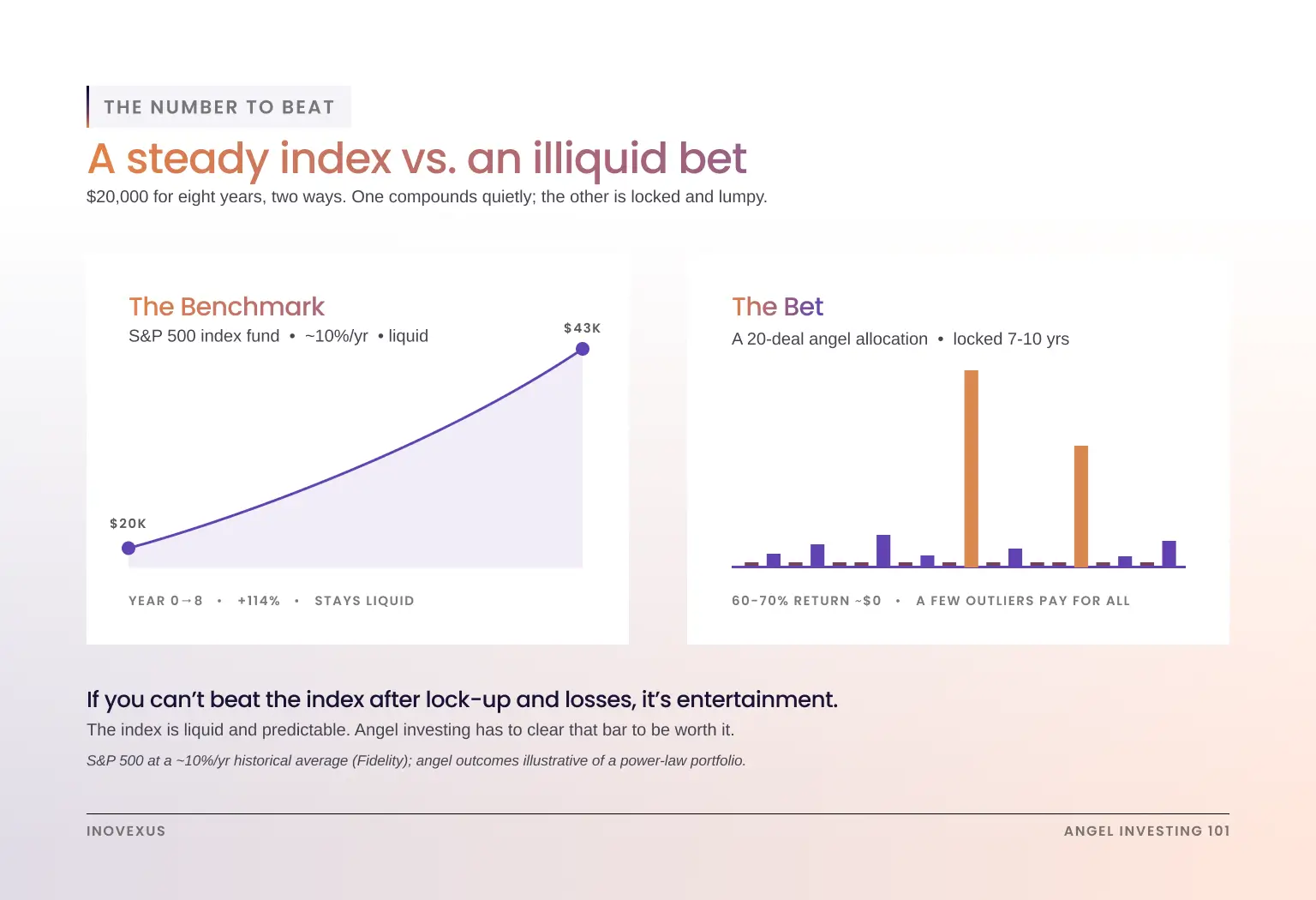
The good news: skill and structure genuinely move the needle. NBER’s 2024 research confirms persistent skill differences among angels — better-performing investors have more industry knowledge, founder connections and active governance. The investors posting 22–31% IRRs tend to run 25-deal portfolios inside their domain of expertise, with 20-plus hours of diligence per cheque. The difference between “bought some stories I liked” and “built an investment program” is the difference between the loss column and the top quartile.
How much money do you really need to start?
Less than most people assume — and this is the shift that has opened angel investing to a new kind of investor.
The old model demanded €25,000–50,000 direct cheques and a personal network deep enough to see good deals. That priced out most successful operators — the CFO, the exited founder, the senior partner who has the capital and the judgment but neither the time nor the deal access.
Two structures changed that:
- Syndicates pool many angels behind a lead investor who sources and diligences the deal. You follow into deals you’d never have seen alone, at a fraction of the cheque size.
- SPVs (Special Purpose Vehicles) bundle all those investors into a single line on the startup’s cap table. Founders love them because they keep the cap table clean; you love them because they lower the minimum. Through an SPV you can often co-invest from around €5–10K per deal.
Do the portfolio math with that in mind. To play the power law properly you want exposure to 20-plus companies, not three — Monte Carlo work on the Wiltbank data suggests you need 22–24 investments for a 90% chance of hitting the distribution’s average return. At €5–10K per SPV position, a serious, diversified first portfolio is a five-figure commitment spread over two to three years — not the six-figure barrier most people imagine. As Hustle Fund’s Eric Bahn puts it, for beginners a bigger portfolio is better: it helps diversification and it helps you get reps in.
One rule, non-negotiable: only invest money you have already written off in your mind. Not “money you can afford to lose” — money you have mentally treated as gone. The 52–70% individual-deal loss rate is not hypothetical. If losing the whole allocation would change your life, this is the wrong allocation.
What is the actual path to becoming an angel? (The 5 steps)
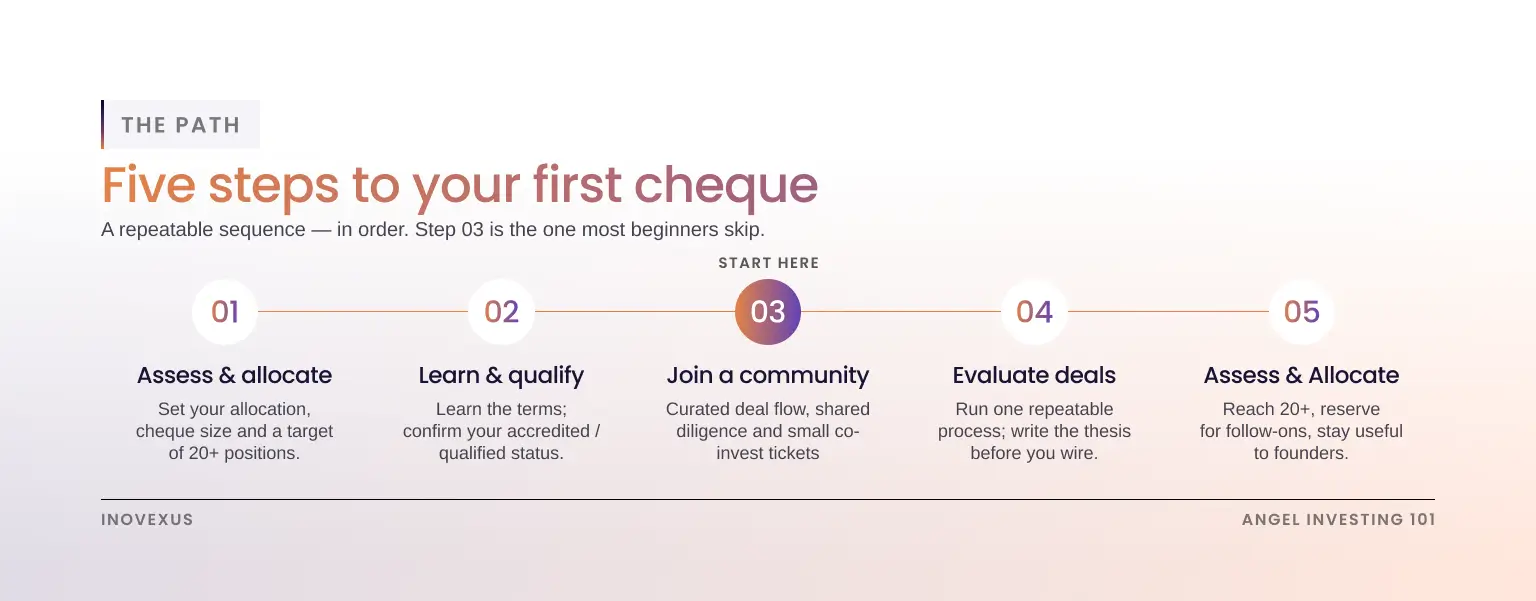
Here is the sequence that works, in order.
Step 1 — Assess your capital and your goals
Decide three numbers before anything else: your total angel allocation (money already written off), your per-deal cheque size, and your target portfolio count (aim for 20+). Then get honest about why you’re doing this — pure returns, learning the ecosystem, strategic exposure to your industry, or backing founders in a space you care about. Your “why” shapes every later decision.
Step 2 — Get educated (and check your eligibility)
Learn the vocabulary that will otherwise cost you money: cap tables, pre- and post-money valuation, SAFEs and convertible notes, liquidation preferences, dilution, pro-rata rights, and what “traction” actually means at each stage. In parallel, confirm your accredited / qualified / sophisticated investor status — the definition and the paperwork vary by country across Europe, and it determines which deals and vehicles you can access. Check your own national regulator’s rules rather than relying on a US “accredited investor” framing.
Step 3 — Join a community or syndicate
This is the step that most changes your odds, and the one solo beginners skip. A good community gives you three things you cannot easily build alone: curated deal flow, shared due diligence from people who’ve done it before, and the ability to co-invest in small tickets alongside experienced angels. How you structure your vehicle — solo, fund, or syndicate — shapes whether you can even access the rare outlier deals in the first place; choosing the wrong vehicle quietly kills returns before a single cheque clears. This is precisely the gap curated communities like Inovexus are built to close.
Step 4 — Evaluate your first deals
Run a repeatable process, not a gut call. For every deal, pressure-test the same things: the team (why them, why now), the market size and timing, the product and its traction signals, the terms and valuation, and the exit logic. Write down your thesis before you invest so you can learn from it later. Beware the two classic first-timer traps: falling for a charismatic founder, and over-indexing on the idea instead of the evidence.
Step 5 — Build a portfolio, then support it
Your first cheque is the start of a program, not an event. Spread your allocation across 20+ companies over time, keep some reserve for follow-on rounds in your winners, and stay useful to founders after the wire clears — introductions, hiring, and honest feedback are where angels earn their reputation and their next deal. This is where the European B2B founders we back tell us the community matters most: capital is common, genuinely helpful investors are not.
Solo angel vs community: which route should a first-timer take?
Every new angel imagines, at least briefly, that they might be the exception: the unusually perceptive beginner who spots quality early, backs conviction over consensus, and builds a portfolio on instinct. The fantasy is understandable. It is also expensive.
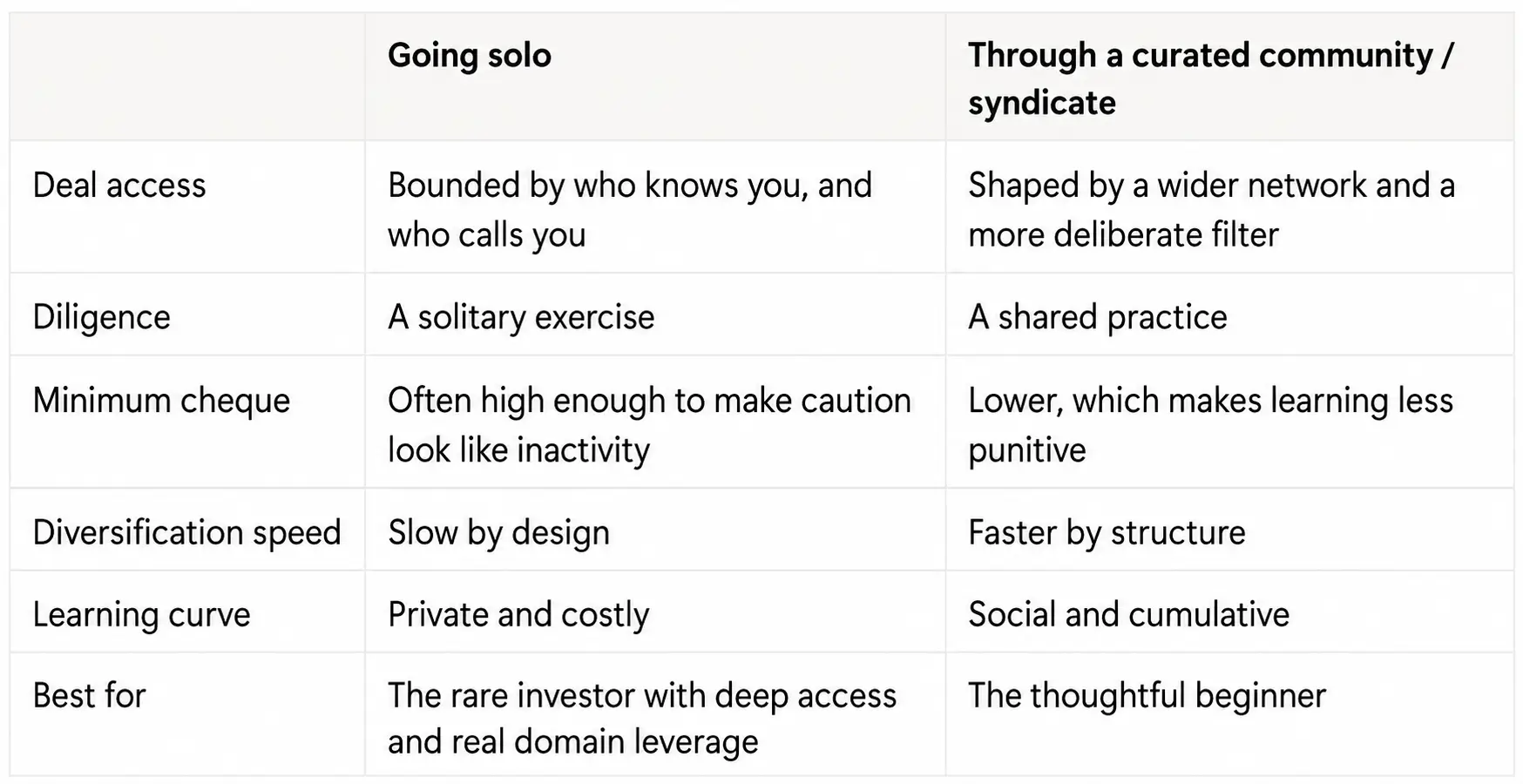
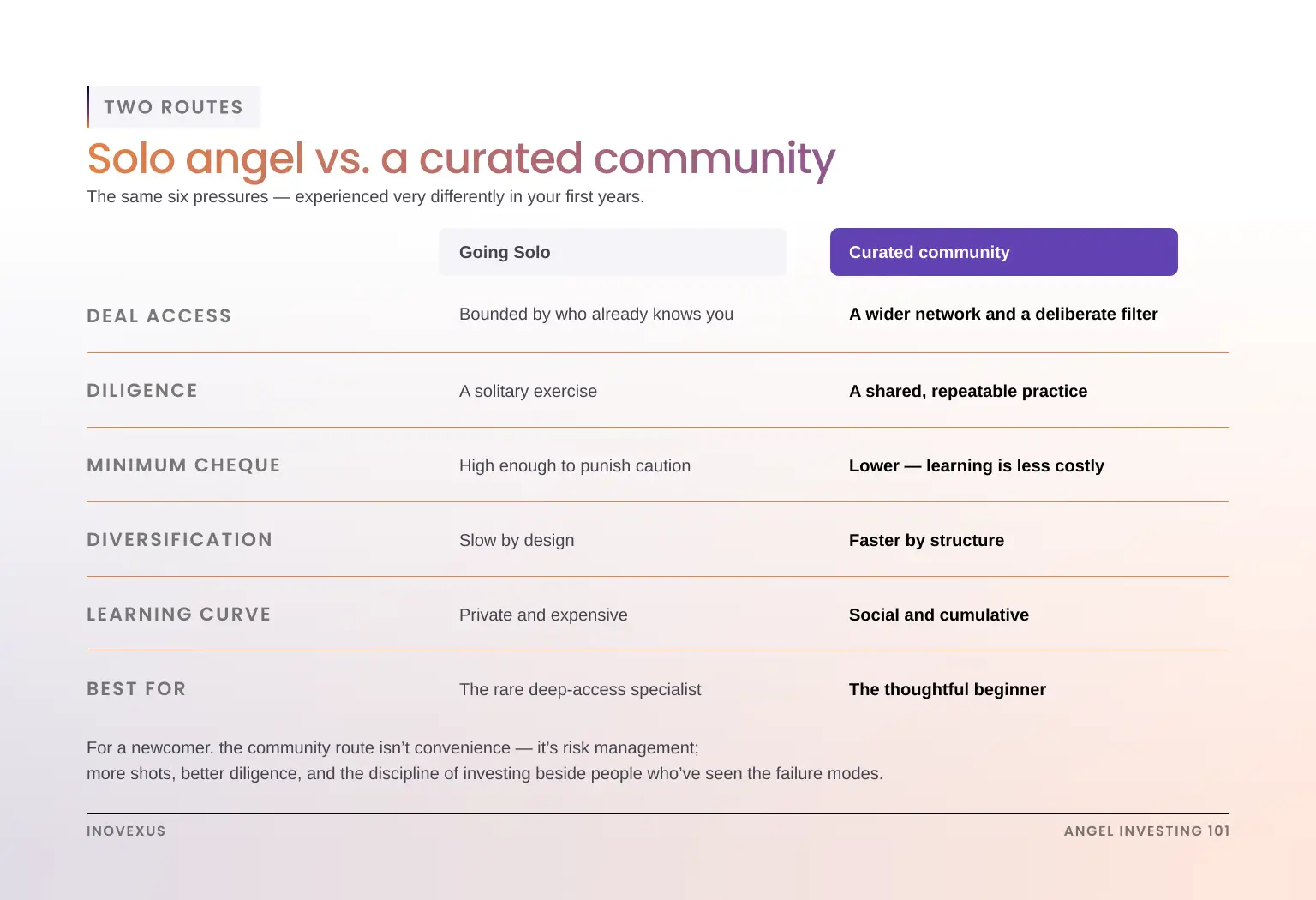
What communities offer is not merely convenience. They offer context. A good one compresses years of isolated trial and error into a pattern-rich environment: more deals, more questions, more ways to see what experienced investors notice before they part with money.
That does not remove the uncertainty. Nothing does. But it changes the texture of the first few years. And in angel investing, the texture of the beginning often determines whether there is a middle at all.
For a newcomer, the community route isn’t a convenience — it’s risk management. One widely-cited body of research suggests community-backed angels see meaningfully higher returns and faster time-to-exit than solo investors, and ACA’s own data is unambiguous that diversification is what makes the asset class work. The mechanism is intuitive: more shots, better diligence, and the discipline that comes from investing next to people who’ve seen the failure modes before.
That is the entire premise Inovexus is built on — a curated community of investors sharing deal flow and co-investing through SPVs, rather than each member going it alone.
The risks nobody puts on the landing page
Credibility means naming what can go wrong. Four things:
- Illiquidity. Your capital is locked for 7–10 years with no secondary market for most positions. Plan your life around never seeing it again until an exit.
- The psychological failure. Even with a rigorous process, the hardest failure is behavioural — chasing hype, doubling down on losers, or letting founder charisma override the evidence. A rigorous process is no guarantee against the psychological failure mode.
- Concentration masquerading as a portfolio. Three deals is not a portfolio; it’s three bets. Skill expressed in a three-deal portfolio disappears into noise.
- Adverse selection. The best deals are competitive. If you only see the deals nobody else wanted, your returns will show it — which loops back to why deal access (Step 3) matters so much, and why sharing curated deal flow through a community is less a perk than a structural fix.
Where the market is heading in 2026
Two forces are worth watching as you start.
First, capital is concentrating in AI and deeptech — AI startups took roughly 80% of Q1 2026 venture funding. A large and growing share of angel deal flow is now AI-adjacent; one 2026 industry estimate puts AI and deeptech at around 48% of angel deals. That’s an opportunity if it’s your domain and a crowding risk if you’re chasing it because everyone else is.
Second, the structure of angel investing is shifting toward syndicates and SPVs — by one 2026 estimate, around 40% of US angel capital now flows through them. The tooling that let a busy executive write a €7K cheque into a vetted deal barely existed a decade ago. That’s precisely the door this guide is showing you through.
We’ll be publishing a full article on this topic soon — check out our blog.
Your first-year roadmap
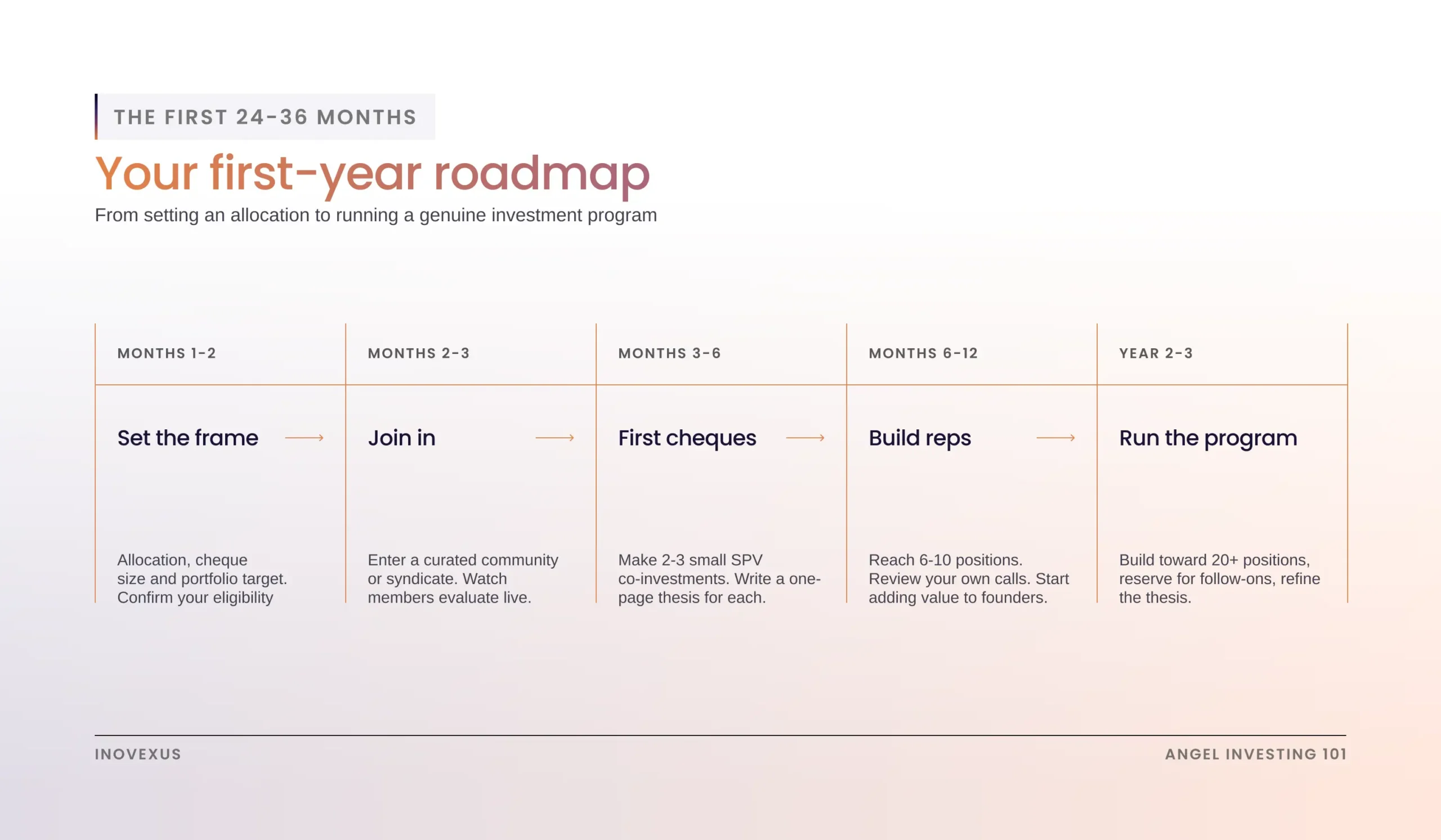
- Months 1–2: Set your allocation, cheque size, and portfolio target. Confirm your investor eligibility. Read the fundamentals.
- Months 2–3: Join a curated community or syndicate. Observe how experienced members evaluate live deals before you commit a cent.
- Months 3–6: Make your first 2–3 small SPV co-investments. Write a one-page thesis for each.
- Months 6–12: Reach 6–10 positions. Start reviewing your own decisions. Begin adding value to founders you’ve backed.
- Year 2–3: Build toward 20+ positions, reserve for follow-ons, and refine your thesis into a genuine investment program.
Questions worth settling before your first cheque
How do I become an angel investor with no experience?
The most sensible route is usually through a curated community or syndicate rather than by going solo immediately. It gives you access to better-filtered opportunities, shared diligence, and smaller ticket sizes while you build judgment.
How much money do I need to start angel investing in Europe?
Less than most people think. Through syndicates and SPVs you can often start from around €5,000–10,000 per deal. What matters more than the per-deal figure is building toward a portfolio of 20+ companies over time, since angel returns follow a power law where a few winners drive nearly all the gains.
Is angel investing profitable?
It can be, but only with discipline. Around 60–70% of angel investments return little or nothing; the returns come from a small number of outliers. Investors who post strong IRRs typically run 25+ deal portfolios in their area of expertise with serious diligence per deal. Treat every euro as money you’ve already written off.
Do I need to be an accredited investor to angel invest in Europe?
Usually yes, in some form — but the exact definition (accredited, qualified, or sophisticated investor) and the paperwork vary by country across Europe. Check your national regulator’s rules, as your status determines which deals and vehicles you can access.
What is an SPV in angel investing?
An SPV (Special Purpose Vehicle) pools multiple investors into a single entity that invests in one startup, appearing as one line on the company’s cap table. It lets founders keep a clean cap table and lets you invest smaller amounts into deals you’d otherwise be priced out of — which is why SPVs have become the standard vehicle for community and syndicate co-investment.
Closing thought
Becoming an angel investor in Europe is less about status than structure. The winners are rarely the people who made one brilliant pick early. More often, they are the ones who understood the game they were entering: illiquid, power-law driven, and impossible to do well without enough shots, enough patience, and enough discipline.
Start smaller than your ego wants to. Build slower than your excitement suggests. Learn in public, write down your reasoning, and let portfolio construction do the heavy lifting.
For most first-time angels, the smartest move is not to begin alone. It is to begin in an environment where deal flow, diligence, and collective judgment are already part of the infrastructure.
If you’re an operator or executive ready to make your first thoughtful cheques, Inovexus is a curated community of investors sharing deal flow and co-investing through SPVs, built precisely for people making the move this guide describes. Explore how membership works when you’re ready.