
Angel investing for executives means backing early-stage startups with your own capital without personally sourcing or diligencing every deal. The route that fits a demanding schedule is co-investment: you join a curated community or syndicate, follow experienced leads into vetted deals through an SPV from around €5,000–10,000, and commit a few hours a month rather than a second job.
That is the short answer. The longer one is about a specific tension every senior operator feels — you have the capital and the judgment to be a genuinely good angel, and almost none of the time the traditional model demands. This guide is about resolving that tension honestly, not pretending it away.
Why do executives make unusually good angels?
Start with the flattering part, because it happens to be true.
The data on who actually becomes an angel reads like a description of a senior operator. In the most comprehensive demographic study of American angels, 36% had held a startup-executive role and another 22.6% came from professional services — lawyers, accountants, senior specialists. The same 2026 industry data finds that roughly 80% of angels have prior entrepreneurial or operating experience, and most start between 40 and 60, once a career has produced both capital and pattern recognition.
That pattern recognition is the asset. A CFO has read hundreds of financial models and knows which assumptions quietly break. A go-to-market leader can tell the difference between real traction and a well-decorated chart in about ninety seconds. An exited founder has lived the failure modes a deck is designed to hide. This is why operator angels — ex-founders and senior executives investing their own capital — have become the most sought-after cheque at pre-seed: founders want the judgment as much as the money.
So the raw material is there. The problem was never capability. It was calendar.
What’s the real problem – and it isn’t money?
Here is the tension stated plainly: the traditional angel model is a part-time job, and you already have a full one.
Done the classic way, angel investing asks you to build proprietary deal flow, screen dozens of companies to find one worth backing, run diligence on the team, market, terms and cap table, negotiate your entry, and then stay useful for the better part of a decade. Industry surveys put active angel involvement at roughly 10–15 hours a month once you include sourcing, diligence, and advising — and that is the average, not the ceiling. The investors posting the best numbers spend well beyond twenty hours of diligence on a single cheque.
For a working executive, that maths simply does not resolve. And the failure mode it produces is predictable: you do one or two deals from your immediate network, under-diligence them because you’re busy, never build a real portfolio, and quietly conclude — on a sample size of two — that angel investing “doesn’t work.” It wasn’t the asset class that failed. It was the operating model.
The honest reframe is this. As an executive, your scarce resource is not capital and not judgment. It is undistracted hours. Any sensible approach to angel investing has to be designed around that constraint, not in spite of it.
How does a community-and-SPV model solve the time problem?
By unbundling the parts of angel investing that eat time from the part where your judgment actually matters.
In the traditional model you own every step. In a curated community built around co-investment, the time-intensive work is shared:
- Sourcing is handled by the network and its leads, not by you cold-scanning the market. You see deals that are already filtered.
- First-pass diligence is done collectively — by people who have run the diligence process before and by peers with domain knowledge you may lack.
- Structuring and admin run through the vehicle. When you co-invest through an SPV, the paperwork, the single cap-table line, and the ongoing administration are handled for you.
What’s left is the part you’re uniquely good at: reading a filtered opportunity, applying your operating judgment, and deciding yes or no. That is the highest-leverage use of an executive’s time, and it’s the only step this model asks you to keep.
The structural shift making this possible is not marketing; it’s measurable. Around 40% of US angel capital now flows through syndicates and SPVs, up from roughly 15% five years ago, and a third of angels investing in 2026 are first-timers — drawn in precisely because lower minimums and shared infrastructure removed the barriers that used to make this a full-time pursuit. The tooling that lets a busy operator write a considered €7K cheque into a vetted deal barely existed a decade ago.
There is a return argument here too, and it’s worth stating without overclaiming. Angel returns follow a power law: most deals return little, a few pay for everything, and the only reliable way to catch the winners is to hold enough positions. Monte Carlo work on the classic Wiltbank data suggests you need somewhere around 22–24 investments for a high chance of hitting the asset class’s average return. Building a portfolio that size solo, at €25,000+ a cheque, is out of reach for most people. Building it at €5–10K per SPV position, a few deals a year, is not. Low-time and well-diversified turn out to be the same strategy.
What does a realistic monthly time budget look like?
Specifics matter more than reassurance, so here is an honest one. For an executive investing through a community, a steady-state month looks roughly like this:
- Deal review — 2 to 3 hours. Read the filtered opportunities the community surfaces. Most you’ll pass on in minutes; one or two a month deserve a closer look.
- Shared diligence — 1 to 2 hours. Read the collective diligence notes, ask your questions, add the one insight your domain gives you that others might miss.
- Decision and admin — under 1 hour. Commit to an SPV or pass. The vehicle handles the paperwork.
- Founder support — as much or as little as you choose. Take the intro call, make the hire, answer the occasional question. This is optional and entirely yours to scale.
Call it four to six focused hours a month to build a real, diversified portfolio over two to three years — against the 10–15 hours the solo route demands before you’ve even started advising. The point is not that the work vanishes. It’s that the work you keep is the work only you can do.
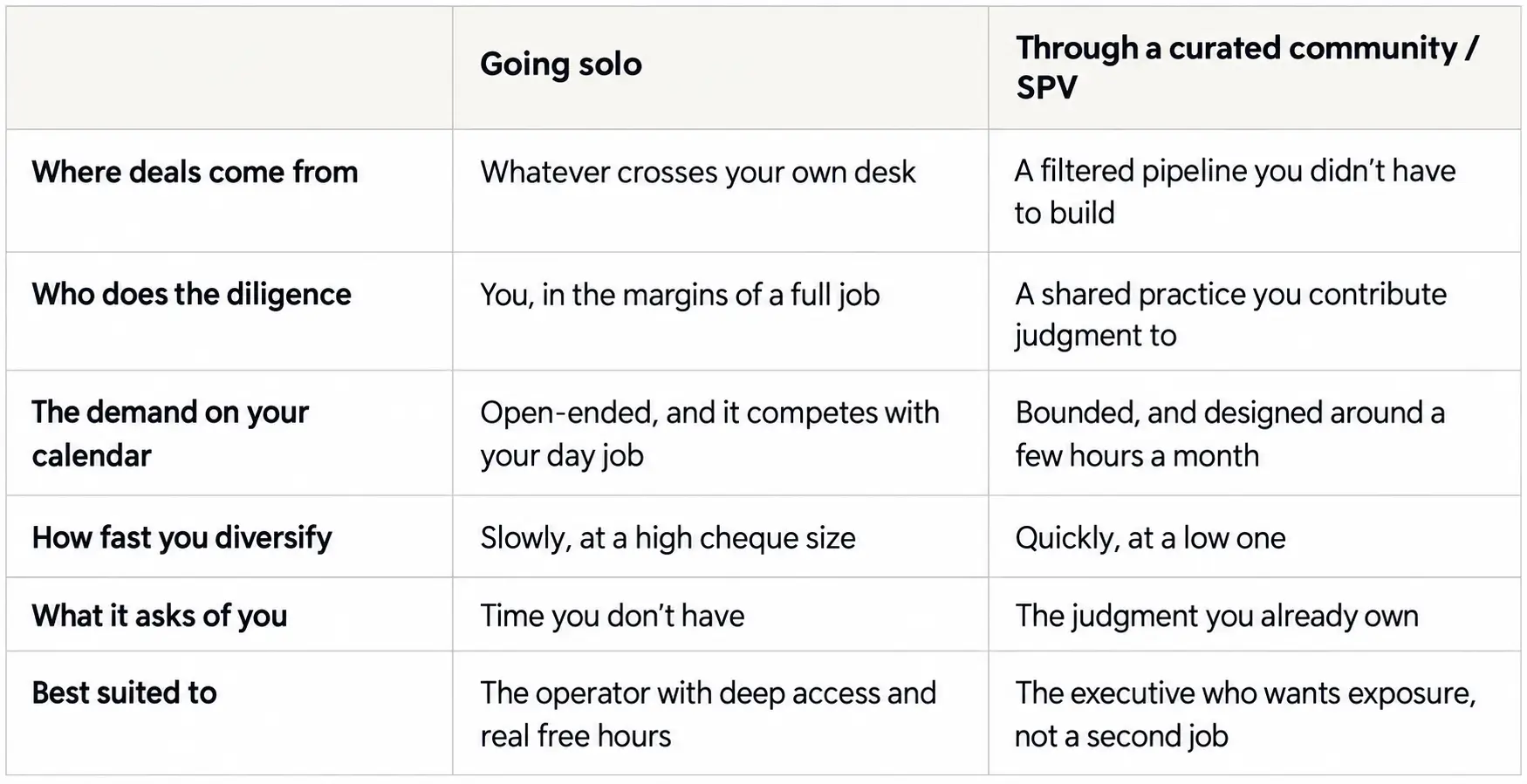
Solo angel vs community: which fits an executive’s constraints?
Every capable operator is tempted, briefly, to do this the hard way — to build the network, run the diligence, and treat angel investing as a craft to be mastered from scratch. For a few people with deep sector access and genuinely free time, that ambition is right. For most executives, it quietly converts a good decision into an abandoned one.
The risks worth naming
Credibility means saying what a low-time model does not fix. Three things:
- Illiquidity is unchanged. Co-investing through an SPV does nothing to shorten the 7–10 year horizon. This is patient capital regardless of how you access it; treat every cheque as money you’ve mentally written off.
- Convenience can dull judgment. The danger in a well-run community is that “the leads did the diligence” becomes a reason to stop thinking. It shouldn’t. Your hours are fewer, so the judgment you apply in them has to be sharper, not absent.
- Curation quality is everything. A low-time model only works if the filtering is genuinely good. The entire value rests on the quality of the community and its deal flow — which is the right question to interrogate before you join anything, ours included.
Where this fits for a busy operator in 2026
The market has quietly reorganised itself around exactly the investor this guide is written for. Capital is concentrating in AI and deeptech, deal structures have shifted toward syndicates and SPVs, and a wave of operators who came into wealth through equity are deploying it through pooled vehicles rather than formal funds. The infrastructure that once made angel investing a full-time undertaking has been unbundled — which is precisely what makes a low-time, high-judgment approach viable now in a way it wasn’t a decade ago.
For an executive, the move is not to carve twenty hours a month out of a schedule that has none. It’s to spend the four or five you can find on the only step that needs you.
We’ll publish a deeper piece on portfolio construction for time-constrained investors soon — it’ll be on our blog.
Questions worth settling before your first cheque
How can I invest in startups without doing all the work myself?
Through a curated community or syndicate that handles sourcing, first-pass diligence, and administration, while you apply your own judgment to already-filtered deals. You co-invest through an SPV from a low minimum — often around €5,000–10,000 — which is how most time-constrained executives build a real portfolio without a second job.
How much time does angel investing actually take?
Done solo, roughly 10–15 hours a month once you include sourcing, diligence, and advising — more if you diligence properly. Through a community that shares the time-intensive steps, a realistic budget is closer to four to six focused hours a month, spent mostly on reviewing filtered deals and applying your judgment.
Why are executives and former founders considered good angel investors?
Because they bring operating pattern recognition money can’t buy. In the largest study of American angels, a large share had held startup-executive or senior professional roles, and operator angels are now among the most sought-after cheques at pre-seed precisely because founders value that experience alongside the capital.
How much money do I need to start?
Less than the traditional model implied. Through SPVs and syndicates you can often begin from around €5,000–10,000 per deal. What matters more than any single cheque is building toward a diversified portfolio over time, since angel returns follow a power law where a few winners drive nearly all the gains.
Is passive or low-time angel investing less profitable?
Not inherently. The low-time route is really a diversification route, and diversification is what makes the asset class work. Spreading smaller cheques across more vetted deals is closer to how the data says you should invest than making one or two large, under-diligenced bets from your own network.
Closing thought
For a senior operator, angel investing has never really been a question of whether you’re capable. You are — the whole ecosystem is quietly built out of people with your background. The question was always whether it could fit a life that’s already full.
The answer, in 2026, is that it can — but only if you stop trying to do it the way people with far more free time do. Spend your scarce hours on judgment, not logistics. Let a good community carry the sourcing, the diligence, and the admin. Diversify through small cheques rather than betting big on the one or two deals you had time to see. Done that way, angel investing stops being a second job you’ll eventually abandon and becomes what it should be for someone like you: a considered use of capital and experience, in the few hours you can actually spare.
If you’re an executive ready to make your first thoughtful cheques without rebuilding your calendar around them, Inovexus is a curated community of investors sharing deal flow and co-investing through SPVs.