What Is an SPV in Angel Investing? A Plain-English Guide
By Inovexus Team. Last updated 23 September 2026.
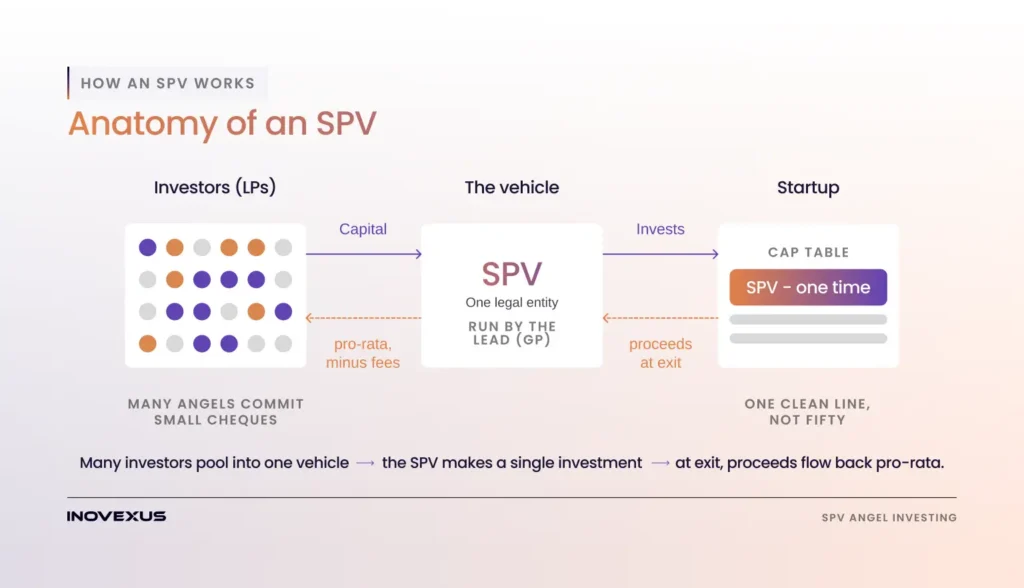
An SPV (Special Purpose Vehicle) is a company created for a single purpose: to pool money from many investors and make one investment, usually in one startup. Instead of fifty angels appearing separately on a startup’s cap table, they invest through the SPV, which shows up as a single line. It is the legal structure that makes syndicated, low-minimum angel investing practical.
That is the definition. What follows is the version you actually need before you wire money into one , how the mechanism works, what you experience as an investor, what it truly costs, the rules that quietly govern it, and how a curated community uses SPVs to let members co-invest in vetted deals from a few thousand euros.
What is an SPV, really?
Strip away the jargon and an SPV is a temporary holding company with one job.
A Special Purpose Vehicle is a single-deal legal entity , almost always a limited liability company , that aggregates capital from a group of investors so they can back one company together. The vehicle, not each individual, becomes the shareholder of record. When the startup eventually exits, the SPV receives the proceeds and passes them to its investors in proportion to what each put in, minus fees.
One distinction clears up most of the confusion: “SPV” describes a purpose, not a legal form. The purpose is to hold one investment; the form is usually a Delaware LLC, sometimes a limited partnership. So when someone says “the SPV,” they mean the single-deal entity; when they say “the LLC,” they’re naming the legal wrapper it happens to use. Same thing, two words.
The structure itself is not new. SPVs originated in the 1980s as off-balance-sheet vehicles used to ring-fence financial risk; startup investing simply borrowed the idea and made it the default way angels pool money. In venture the roles have specific names: the lead (or GP) sources the deal, forms the vehicle, and runs it; the investors (the LPs, or “backers”) commit their individual cheques; the SPV is the entity that holds the shares. Keep those three roles in mind and every fee, form and mechanic below becomes easy to follow.
What does investing through an SPV actually feel like?
Most explainers stop at the definition. Here is what actually happens to you, in the order you live it , because the lived sequence is what newcomers find genuinely confusing.
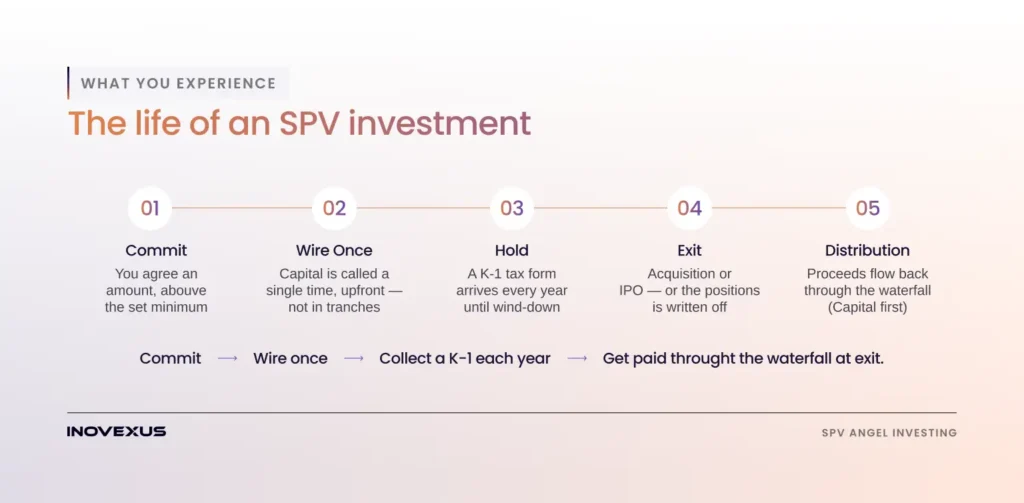
- You commit. You agree to put in a set amount, subject to the minimum the SPV sets.
- Your capital is called once, upfront. You wire the full amount when the deal closes. This matters: in an SPV, capital is almost always called a single time, unlike a traditional venture fund that draws your money in tranches over several years. If you’ve heard of capital calls hitting an account for years, that’s funds , not SPVs.
- The SPV signs the deal. The vehicle executes the SAFE, convertible note, or stock-purchase agreement with the startup.
- The SPV lands on the cap table. One line, one investor of record, no matter how many LPs sit behind it.
- A K-1 arrives every year. For as long as the SPV exists, each investor receives a Schedule K-1 (or its local equivalent) at tax time. A K-1 is not a bill , it’s a tax form reporting your share of the entity’s gains and losses. Expect one each spring for the life of the deal, which can be five to ten years. It doesn’t mean anything is wrong; it’s simply how a pass-through vehicle reports.
- The deal resolves. The startup exits via acquisition or IPO, or it fails and the position is written off.
- Capital comes back first, then carry splits the rest. At a profitable exit, proceeds first return your original investment, and only the profit above that is split , with the lead taking a percentage as carried interest.
That sequence is the whole life of the investment: commit, wire once, collect a K-1 each year, and get paid through the waterfall at exit.
How does the distribution waterfall work?
The order of payout is where a lot of first-timers misjudge their returns, so it’s worth stating precisely.
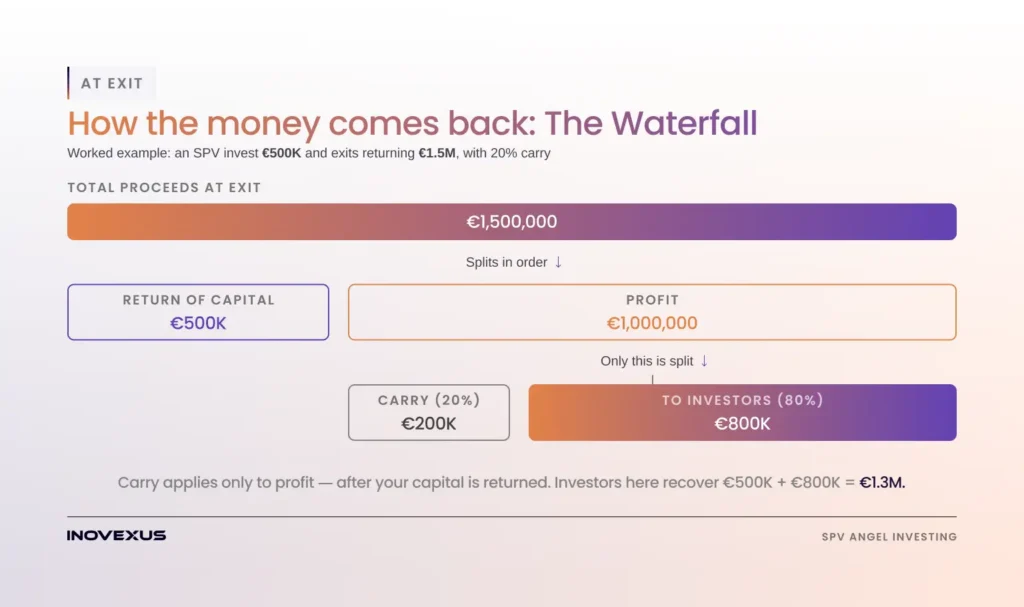
When the SPV exits, proceeds are distributed in a fixed order , a “waterfall.” First, each investor’s original capital is returned. Only the profit above that return of capital is then split, with the lead taking their carry off the profit and the rest flowing to investors pro-rata. In practice: if an SPV invests EUR 500,000 and returns EUR 1,500,000, the first EUR 500,000 goes back to investors as return of capital; the EUR 1,000,000 of profit is what carry applies to. At 20% carry, the lead takes EUR 200,000 and investors share the remaining EUR 800,000, on top of their returned capital.
The point to internalise: carry is charged on profit, not on the whole exit , but on a big win, that profit is large, which is why carry, not the setup fee, is the cost that actually shapes your net return.
Why do founders prefer one clean line on the cap table?
Because the alternative is an administrative burden that follows them for years.
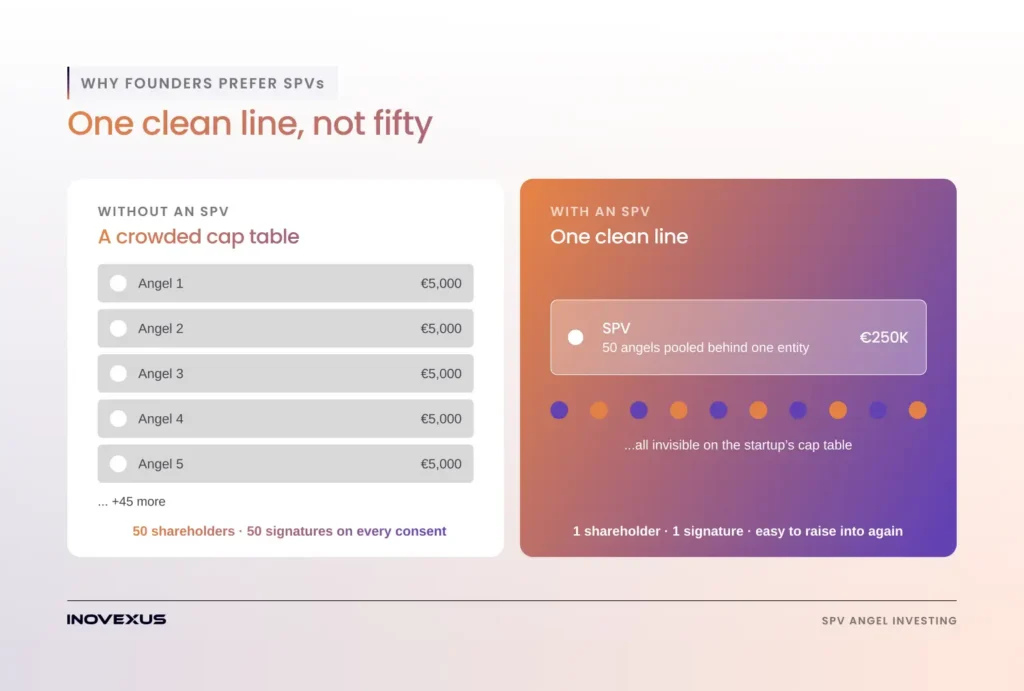
Imagine raising $500,000 from 100 angels writing $5,000 cheques each. Without an SPV, that is 100 separate shareholders , 100 signatures on every future consent, 100 sets of information rights, 100 people to update. With an SPV, the startup deals with one entity, and the individual investors never clutter the cap table. A single vehicle can hold a large group of investors behind that one line.
This matters far beyond tidiness. A messy cap table , dozens of small direct holders , creates real friction in future rounds: later investors scrutinise it, and every shareholder consent becomes a coordination exercise. A clean cap table signals a company that is easy to invest in again. The fifty LPs behind the SPV are invisible on the cap table, which is exactly what a startup’s board wants.
So the SPV solves two problems at once: for founders, it collapses a crowd into a single manageable line; for investors, it unlocks access to deals whose minimums would otherwise be out of reach.
SPV vs fund: what’s actually different?
This is the comparison newcomers most often get wrong, and it comes down to one word: blindness.
An SPV holds one company. A fund holds many. When you invest in an SPV, you see the exact company before you commit , you’re making one decision about one startup you can diligence. When you invest in a fund, you’re backing a manager’s future picks, most of which don’t exist yet when you wire the money , the “blind pool.” You’re buying the manager’s judgment, not a specific deal.
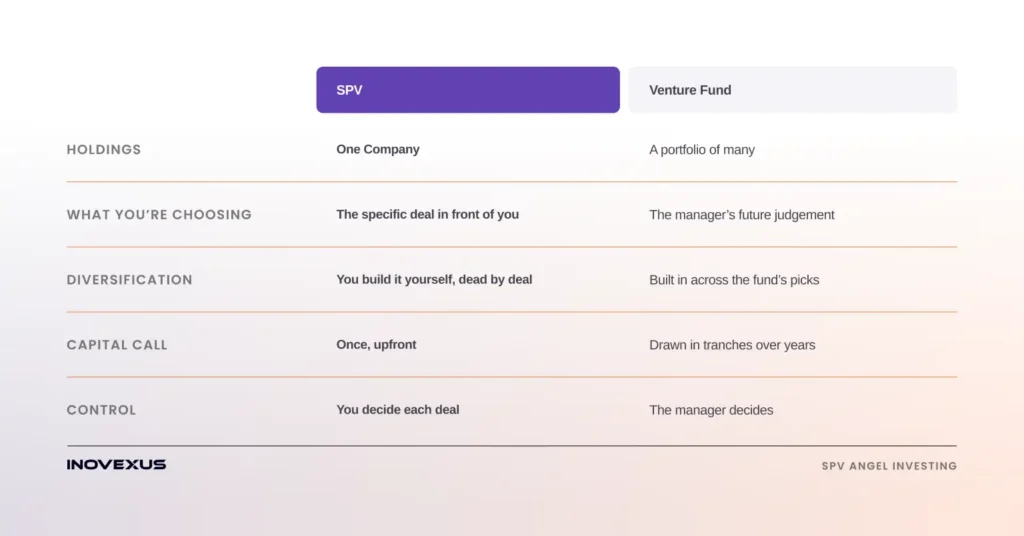
Each has its place. An SPV gives you control over every decision and full visibility into what you’re backing; a fund gives you diversification without the per-deal work. Communities and syndicates favour SPVs precisely because members want to see , and choose , each company.
What does an SPV actually cost?
The headline number is never the whole number. There are three layers, and a disciplined investor understands all three.
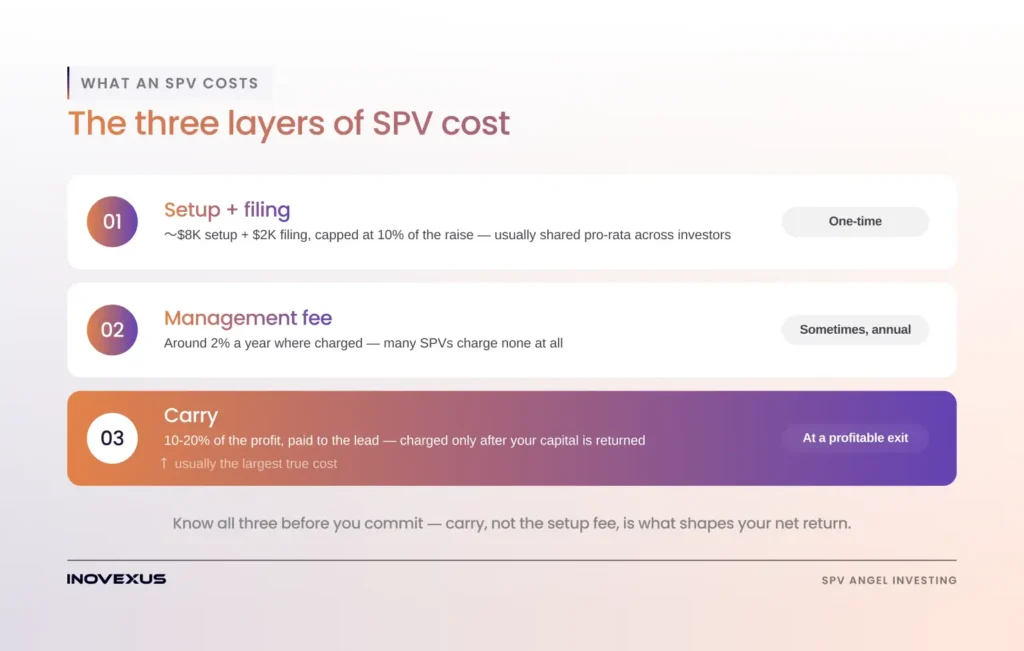
1. Setup and admin. The one-time cost of forming and running the vehicle. On AngelList, the standard SPV setup fee is $8,000 plus a $2,000 state filing fee, capped at 10% of the amount raised. Other administrators price differently , Sydecar charges 2% of the raise plus a regulatory fee; Allocations charges a flat ~$9,950 , but the shape is the same: a fixed cost, usually spread pro-rata across all investors.
2. Management fee. Some leads charge an annual fee on assets. Historically many charged nothing, but that is shifting: the share of larger SPVs charging a management fee rose from 41% in 2021 to 67% in 2023, and where a fee is charged, the median sits near 2% , the classic “2 and 20” shorthand (2% management fee, 20% carry).
3. Carry. The lead’s share of the profits , the cost that matters most. Carry typically runs 10-20% of gains, charged only after your capital is returned (see the waterfall above).
One trap worth naming: fees as a percentage of a small raise can be brutal. A $10,000 setup cost is negligible on a $500,000 SPV but is 10-20% of a $50,000 one , which is why platforms enforce minimum raises, and why the quality of the vehicle you invest through matters as much as the deal inside it. Some newer platforms flip the model and charge the angel a capped per-cheque fee instead of the lead; the lesson is simply to know exactly what you’ll pay before you commit.
How big has SPV investing become?
Big enough that it has quietly reshaped how early-stage deals get done.
The global SPV services market was valued at roughly $12-14 billion in 2024-2025 and is projected to grow toward $20-27 billion over the next decade, and 89% of GPs expect SPV deal volumes to keep growing. On Carta, the number of new SPVs formed annually is up 116% compared with five years ago, and the vehicles are getting larger , the median SPV managed $2.17 million in assets in 2023, up from $1.18 million in 2016. At Sydecar, SPVs raised a cumulative $476 million in a single recent year, more than double the prior year.
In angel investing specifically the direction is unambiguous: by one 2026 estimate, around 40% of US angel capital now flows through syndicates and SPVs, up from roughly 15% five years earlier.
Co-invest without the overhead
At Inovexus, members co-invest in vetted, curated deal flow through SPVs , so you get one clean position in a startup from a low minimum, with the sourcing, diligence, and administration already handled. It’s the structure this article describes, run for you rather than by you.
Who can invest in an SPV, and how many?
Two rules quietly shape every SPV you’ll ever see: who is allowed in, and how many.
Who: accredited (or equivalent) investors only. In the US, SPVs almost always raise under Regulation D, the exemption that lets private companies sell securities without a public registration , which restricts them to accredited investors. In Europe there’s no single “accredited investor” label; instead, offers are typically limited to those who qualify as professional or elective-professional clients under MiFID II, and the exact thresholds and paperwork vary by country. The practical takeaway for a European investor: check your own national regulator’s rules rather than assuming the US framing applies.
How many: fewer than you’d think. Most SPVs are structured so that, under the Investment Company Act’s 3(c)(1) exemption, they’re limited to roughly 100 beneficial owners. A narrower “qualifying venture capital fund” exemption permits up to 250 investors below a statutory size threshold. This cap is why minimum cheques exist: to fit a $500,000 raise under a ~100-person limit, you need average cheques around $5,000 , and it’s why “the round is full” sometimes really means the vehicle has hit its investor cap.
What are the benefits and the limits of an SPV?
Set out plainly, so you can judge for yourself.
The benefits
- Access. A single SPV lets a smaller cheque sit beside a large one and get the same pro-rata economics in a deal that would otherwise be closed to it.
- Diversification. Angel returns follow a power law , most deals return little, a few pay for everything , so you need enough positions to catch a winner. Small SPV cheques let you build that breadth without a fund-sized budget.
- Limited liability. Because the SPV is a separate legal entity, your exposure is generally capped at what you contribute , the vehicle’s obligations don’t reach your personal assets.
- Simplicity. The vehicle handles the paperwork, the K-1s, and the compliance for its lifetime.
The limits
- Fees compound against you. Setup, management fee and carry stack; on a strong exit the carry alone can be the largest single cost. Understand the full stack before committing.
- Illiquidity is unchanged. An SPV does nothing to shorten the 7-10 year horizon, and selling your SPV interest early is usually difficult , often only to another member of the same vehicle, if at all.
- You’re a passive LP. You don’t get a board seat, you don’t negotiate terms, and you don’t sign the deal docs , the lead does all of that. You’re backing their judgment on this specific deal.
- You’re trusting the lead. The lead has a fiduciary duty, but sourcing, diligence and governance rest on them. A well-run community adds a layer of collective scrutiny a solo lead can’t; a poorly-run one just adds a fee.
Is investing through an SPV a good idea?
Here’s the reframe that keeps you honest: an SPV is a structure, not an asset class.
Asking whether an SPV is a good investment is like asking whether a checking account is a good investment. The wrapper doesn’t make or lose money , the company inside it does. A cheap SPV around a mediocre deal returns less than a fair SPV around a great one. So while you should absolutely understand the fees, the fee is the smallest number in your return math. What drives your outcome is the quality of the deals you can access, how well they’re diligenced, and the discipline to build a diversified portfolio rather than a single bet.
Which is exactly why where you meet your SPVs matters. At Inovexus, this is the mechanism behind member co-investment: a curated community surfaces vetted deals, members co-invest through an SPV from a low ticket, and the vehicle carries the load , the structural fix that lets a busy investor build a real portfolio a few thousand euros at a time. In Europe specifically, SPV infrastructure now spans jurisdictions like Luxembourg and France, making cross-border angel co-investment practical in a way it wasn’t a decade ago.
Questions worth settling before your first SPV
What is an SPV in simple terms?
An SPV (Special Purpose Vehicle) is a company set up for one investment. It pools money from many investors and puts it into a single startup, appearing as one line on that startup’s cap table instead of dozens of individual names. It’s the standard way angels co-invest in a deal together.
How does an SPV make money for investors?
When the startup exits, the SPV receives the proceeds and distributes them in a waterfall: each investor’s original capital is returned first, then the remaining profit is split, with the lead taking carry and the rest going to investors pro-rata to their stake.
When do I pay, and how often?
Once. SPV capital is almost always called a single time, upfront , you wire the full amount when the deal closes. Ongoing capital calls over years are a feature of venture funds, not SPVs. You will, however, receive a tax form (a K-1 or local equivalent) each year until the vehicle winds down.
How much does an SPV cost?
Typically a one-time setup fee (on AngelList, $8,000 plus a $2,000 filing fee, capped at 10% of the raise), sometimes an annual management fee near 2%, and carry of 10-20% of profits paid to the lead , charged only after your capital is returned. Carry is usually the largest true cost.
Is an SPV the same as a fund?
No. An SPV backs one company for a single deal that you can see before committing; a fund raises capital and invests it across many companies the manager picks later. An SPV is simpler, cheaper to run, deal-specific, and gives you control over each decision , which is why syndicates and communities use them for co-investment.
Closing thought
An SPV is not exotic financial engineering. It is a piece of plumbing , a single-purpose company that turns a crowd of small cheques into one clean investment, solving the founder’s cap-table problem and the investor’s access problem in the same move.
For an individual angel, understanding the vehicle matters because the vehicle shapes the economics: know the three cost layers, respect the waterfall and the illiquidity, and pay attention to who is running it. But never mistake the wrapper for the win. The SPV just gets you cleanly into the deal , what determines your returns is the quality of the deals you see and the discipline to hold enough of them.
If you’d rather co-invest through vetted SPVs without building the infrastructure yourself, Inovexus is a curated community of investors doing exactly that , sharing deal flow and co-investing from a low minimum.